How To Select And Match Fixed End Bearings in Marine Motor Bearing Systems?
Jul 23, 2023
For the selection of the fixed end of the marine motor bearing support (referred to as the motor fixed end), the following factors should be considered: (1) accuracy control requirements of the driven equipment; (2) The load characteristics of marine motor drive; (3) Bearings or bearing combinations must be able to withstand a certain axial force. Based on the above three design elements, deep groove ball bearings are selected as fixed end bearings for small and medium-sized marine motors.
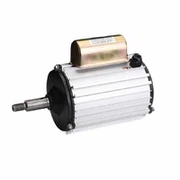
Marine motor
Deep groove ball bearings are commonly used rolling bearings. When using deep groove ball bearings, the structure of the marine motor bearing support system is very simple and maintenance is also very convenient. Deep groove ball bearings are mainly used to withstand radial loads, but when the radial clearance of the bearings increases, they have the characteristics of angular contact ball bearings and can withstand combined radial and axial loads; When the rotational speed is high and the thrust ball bearing is not suitable, it can also be used to withstand pure axial loads. Compared with other types of bearings of the same specification and size as deep groove ball bearings, this type of bearing has the advantages of low friction coefficient and high ultimate speed, while its disadvantage is that it is not resistant to impact and is not suitable for carrying heavy loads.
After installing the deep groove ball bearing on the shaft, the radial fit in both directions of the shaft or shell can be limited within the axial clearance range of the bearing. In the radial direction, the bearing and shaft adopt an interference fit, and the bearing and end cover bearing cavity or bearing seat adopt a small interference fit. The purpose of selecting this type of fit is to ensure that the working clearance of the bearings during the operation of marine motors is zero or slightly negative, thereby ensuring good operating performance of the bearings. In the axial direction, the axial fit between the positioning bearing and related components should be determined based on the specific situation of the floating end bearing system. The inner ring of the bearing is limited by the limit step (shoulder) of the bearing position on the shaft and the bearing retainer ring, while the outer ring of the bearing is controlled by the fit tolerance between the bearing and the bearing chamber, the height of the inner and outer bearing covers, and the length of the bearing chamber.
(1) When using separable bearings with inner and outer rings for the floating end, the outer rings of the bearings at both ends are free to fit with axial clearance.
(2) When selecting non separating bearings for the floating end, there should be a certain length of axial clearance between the outer ring of the bearing and the bearing cover lip, and the fit between the outer ring and the bearing cavity should not be too tight.
(3) When the marine motor does not have a clear positioning end and floating end, deep groove ball bearings are generally used at both ends, and the matching relationship between the outer ring of the limit bearing and the inner cover is stuck, with axial clearance with the outer cover; Or the matching between the axial direction of the outer ring of the bearings at both ends and the outer cover of the bearings without clearance, and the axial direction of the inner cover with clearance.
Marine motor
According to theoretical analysis, the above matching relationship is relatively reasonable. The actual bearing configuration should match the operating conditions of the marine motor, including specific parameters such as clearance, heat resistance, accuracy, etc. when selecting bearings for the marine motor, as well as the radial matching relationship between the bearings and the bearing cavity.
It should be noted that the above analysis is only applicable to horizontally installed marine motors, while for vertically installed marine motors, there must be specific requirements for both bearing selection and related matching relationships.